Best 144Hz 4K And 1440p Monitors For Smooth, Crisp Gaming
Best 144Hz 4K And 1440p Monitors For Smooth, Crisp Gaming
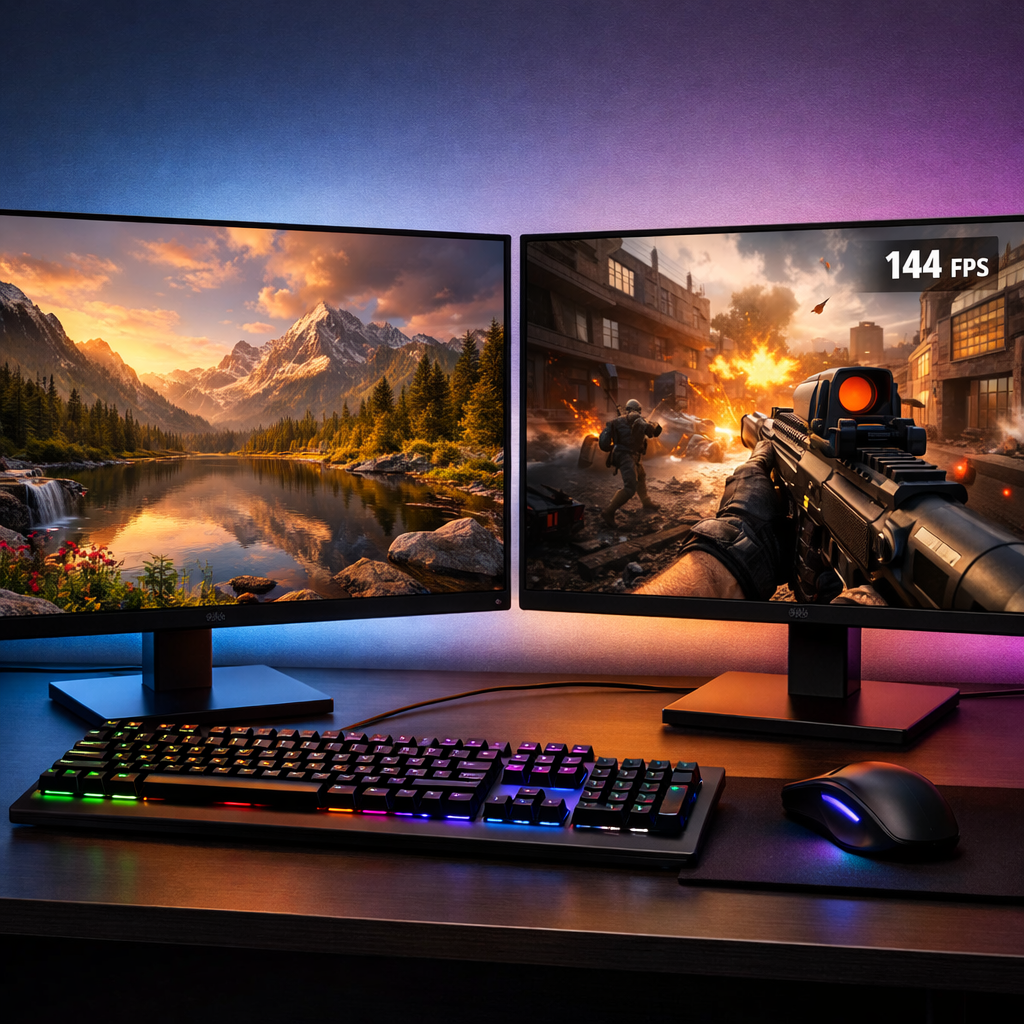
High-refresh-rate gaming comes down to two winning paths: 1440p at 144–240Hz for the best blend of smoothness, value, and reasonable GPU demand; or 4K at 144–240Hz for unmatched sharpness and HDR, if you have the horsepower and budget. At Gaming Device Advisor, we prioritize frame-time stability, noise-normalized thermals, and sustained performance over spec-sheet peaks. A high-refresh monitor updates the image 144 times per second or more, which reduces motion blur and input latency so fast games look and feel noticeably smoother. Below, we name the best gaming monitor 144Hz or higher for different needs, and explain how to choose between 1440p and 4K 144Hz.
Gaming Device Advisor Top Pick
If you want smooth, crisp gaming with sane GPU loads, get a 27-inch 1440p 180–240Hz IPS with Adaptive Sync and strong factory color. Models like LG’s 27GR83Q or Asus’s TUF VG27AQL3A deliver 1ms-class response, wide DCI-P3 coverage, and excellent motion clarity without exotic cooling or noise spikes, matching the trend of capable, affordable 27-inch 1440p panels highlighted by independent roundups such as TechRadar’s best monitors coverage.
For image-first enthusiasts running flagship GPUs, a 27–32-inch 4K 240Hz QD‑OLED like Asus’s PG27UCDM or MSI’s MPG 321URX offers elite contrast and HDR with per-pixel response—just budget for bandwidth (HDMI 2.1/DisplayPort 2.1) and the GPU to sustain 4K 144Hz+ in modern titles, as noted by TFTCentral’s ongoing recommendations.
Why it fits Gaming Device Advisor: these picks balance fast response and VRR stability with cool, quiet operation and sustained brightness—prioritizing consistent frame-time over fleeting peak numbers.
How We Chose Monitors For Smooth, Crisp Gaming
At Gaming Device Advisor, we evaluate what keeps gameplay fluid and systems quiet over long sessions: motion performance at 144Hz+, VRR behavior across fluctuating FPS, HDR implementation, panel uniformity, thermals and sustained brightness, and sane 24/7-safe settings. We cross-check measurements (response times, color coverage via colorimeters) and long-term behavior across Gaming Device Advisor buyer’s guides and trusted labs that update their findings frequently, including RTINGS’ best monitors hub and Tom’s Hardware’s monitor testing.
VRR definition (40–50 words): Variable refresh rate synchronizes the display’s refresh with the GPU’s frame output to reduce tearing and stutter. It keeps motion smooth when FPS fluctuates, improving responsiveness and visual stability. Widely supported standards include AMD FreeSync and Nvidia G‑Sync Compatible on modern gaming monitors.
1. Asus ROG Swift PG27UCDM
Asus’s ROG Swift PG27UCDM is a flagship 27-inch 4K 240Hz QD‑OLED built for those chasing elite HDR, perfect blacks, and top-tier motion clarity. With modern high-bandwidth inputs (DisplayPort 2.1/HDMI 2.1) and Dolby Vision support, it targets competitive 4K setups where every frame and pixel counts, aligning with TFTCentral’s high-end recommendations.
- Who should buy: visual-first players with a top-tier GPU who want 4K 144Hz+ without compromising HDR or responsiveness.
- Stability note: understand OLED ABL behavior and enable built-in burn-in mitigations; see our burn-in section for 24/7-safe use tips.
2. MSI MPG 321URX
MSI’s MPG 321URX is a value-forward 32-inch 4K 240Hz QD‑OLED that punches above its price for contrast, color, and HDR immersion. It’s superb for cinematic single-player and HDR-first gaming at a larger size.
- Connectivity check: for true 4K 144–240Hz at full fidelity, ensure DisplayPort 2.1 or HDMI 2.1 end-to-end—and a GPU strong enough to hold refresh in demanding games—echoing guidance from TFTCentral.
- Tuning tip: enable VRR, use DLSS/FSR quality or balanced modes, and cap FPS slightly below max refresh to keep frame pacing consistent.
3. Asus ROG Strix XG32UCWMG
The ROG Strix XG32UCWMG is a flexible 32-inch WOLED 4K 240Hz with dual-mode that unlocks 1080p 480Hz for esports. Toggle between razor-sharp 4K HDR and ultra-high refresh for competitive sessions without changing displays.
- Dual-mode explained: it downshifts resolution to achieve extreme refresh rates—ideal for hybrid users who split time between cinematic AAA and maximum-FPS shooters.
- Who benefits: players balancing competitive titles and HDR blockbusters who want one monitor to do both exceptionally well.
4. Asus ROG Swift PG32UCDM
The PG32UCDM scales QD‑OLED up to 32 inches, preserving 4K 240Hz clarity with a larger canvas for immersion and more comfortable text/UI sizing.
- Upgrade path: moving from 27 to 32 inches increases immersion but raises GPU demand to sustain 144Hz+ at 4K; ensure bandwidth (HDMI 2.1/DisplayPort 2.1) and a high-end GPU, consistent with TFTCentral’s 4K 144Hz+ guidance.
- Desk fit and viewing distance: 70–90cm keeps perceived sharpness high and reduces eye strain at 32 inches.
5. Dell Alienware AW2725Q
Alienware’s AW2725Q is a well-regarded 27-inch 4K QD‑OLED alternative praised for gaming fidelity and rapid response among 4K options, making it a strong pick for solo AAA/HDR titles and light content-creation crossover thanks to deep contrast and wide color. As with all 4K OLEDs, confirm HDMI 2.1/DisplayPort 2.1 and bring a strong GPU for high-refresh 4K, a theme echoed in Trusted Reviews’ top monitor coverage.
6. Acer Nitro XV275K
For a more budget-friendly entry into 4K 144Hz, Acer’s Nitro XV275K prioritizes resolution while keeping costs approachable. Budget 4K 144Hz-capable models can require the right bandwidth and sometimes rely on DSC; verify your chain to avoid leaving refresh or color depth on the table, a point reinforced by RTINGS’ connectivity notes.
Simple unlock checklist:
- Port type on monitor: DP 2.1 or HDMI 2.1
- Cable: certified Ultra High Speed HDMI 2.1 or DP 2.1
- GPU output: matching DP 2.1/HDMI 2.1 port present
- Driver setting: set 4K/144Hz with full color depth (avoid forced 4:2:0)
Non‑OLED note: IPS/Mini‑LED options can hit higher full-screen brightness in bright rooms and carry no burn-in risk—useful for mixed work/play.
7. LG 27GR83Q
The LG 27GR83Q is a balanced 27-inch 1440p high-refresh IPS pick that pairs crisp motion with forgiving GPU requirements. Many 27-inch 1440p models now hit ~180Hz, 1ms response, and wide DCI-P3 gamut coverage at attainable prices, mirroring market trends covered by TechRadar.
- Ideal for: competitive and variety gamers prioritizing stable high FPS, low input lag, and quiet thermals.
- Setup tip: enable Adaptive Sync and cap FPS 2–3 frames below refresh for consistently smooth frame-time and lower fan noise.
8. Asus TUF Gaming VG27AQL3A
The VG27AQL3A is a standout affordable 27-inch 1440p option with excellent out-of-box color and broad VRR support (AMD FreeSync Premium and G‑Sync Compatible). Built-in speakers are weak, but motion and color fidelity impress for the price—an easy way into 1440p high refresh that won’t overtax midrange GPUs, aligning with PCMag’s mainstream monitor guidance.
- Quick setup: disable the internal speakers and use headphones or desktop speakers for better audio.
9. AOC Q27G3XMN
AOC’s Q27G3XMN is a popular value 1440p high-refresh VA that delivers strong native contrast for visually rich titles. It embodies why 1440p 144Hz+ remains so compelling—higher sustained frame rates for competitive play and broad, budget-friendly choices, a pattern reflected in RTINGS’ best-of lists.
- Tuning tip: enable overdrive conservatively to avoid inverse ghosting; test multiple levels and pick the cleanest moving edges, as reviewers demonstrate in the AOC Q27G3XMN video review.
Buying Guide For 144Hz 4K And 1440p
How to choose:
- Pick resolution: 1440p for higher sustained FPS; 4K for per-pixel sharpness and HDR.
- Choose panel tech: IPS/VA for brightness and longevity; QD‑OLED/WOLED for elite contrast/HDR.
- Verify ports: DisplayPort 2.1 or HDMI 2.1 for 4K 144Hz+.
- Confirm VRR: Adaptive Sync (FreeSync Premium, G‑Sync Compatible).
- Plan thermals/noise: cap FPS slightly below refresh; prioritize stable frame-time over max FPS spikes.
Comparison at a glance:
| Tier | Pros | Cons | GPU needs | HDR quality | Cost |
|---|---|---|---|---|---|
| 1440p 144–240Hz | Excellent motion, easier FPS stability, broad value | Less per-pixel detail | Mid–high tier | Good (varies by panel) | Lower |
| 4K 144–240Hz | Best sharpness, premium HDR (OLED/Mini‑LED) | Heavy GPU demand, bandwidth checks | Top tier | Excellent | Higher |
Resolution And Refresh Tradeoffs
Core tradeoff: 1440p at high refresh offers higher sustained frame rates and superb motion for esports, while 4K 144–240Hz delivers superior detail and HDR at significantly higher GPU and budget requirements, as reflected in RTINGS’ buying advice and TFTCentral’s 4K recommendations. Refresh rate is how often a display updates per second (Hz). Higher refresh reduces perceived blur and input latency, making fast games more responsive.
Recommended profiles:
- Competitive shooters: 1440p at 180–240Hz.
- Visual-first AAA/HDR: 4K 144–240Hz QD‑OLED/WOLED with a top-tier GPU.
Panel Technology And HDR Quality
- IPS: wide color, fast response, strong brightness; great all-rounder for bright rooms.
- VA: higher native contrast; can smear if overdrive is poorly tuned.
- OLED/QD‑OLED/WOLED: near‑instant response, perfect blacks, premium HDR; manage burn‑in risk with built-in protections.
Example HDR performer: Acer’s Predator X32 FP is noted for vivid color, high brightness, four HDMI 2.1 ports, and VESA DisplayHDR 1000 certification, illustrating how Mini‑LED/IPS can excel for bright-room HDR, as covered by Trusted Reviews. Note that some displays ship with limited HDMI ports—HDMI 2.0 can constrain 4K120/HDR on consoles—so verify the spec.
VRR, Input Lag, And Frame-time Stability
Input lag (40–50 words): Input lag is the delay between your command (mouse/keyboard) and the on-screen result. Lower lag improves responsiveness and aim consistency. High-refresh monitors and gaming modes minimize display processing, and when paired with VRR and stable frame delivery, they preserve smooth, tear-free motion.
Adaptive Sync (FreeSync Premium, G‑Sync Compatible) is now common on 1440p monitors and essential when FPS fluctuates, a point reiterated across mainstream guides and in Gaming Device Advisor’s recommendations.
Simple smoothness setup:
- Enable VRR in the monitor OSD and GPU control panel.
- Cap FPS 2–3fps below max refresh to avoid hitting the VRR ceiling.
- Use Nvidia Reflex/AMD Anti‑Lag as needed.
Ports, Cables, And Bandwidth Requirements
Display bandwidth is the maximum data rate your port/cable can carry. Hitting 4K at 144Hz with high color depth typically requires DisplayPort 2.1 or HDMI 2.1; older standards may force lower refresh, chroma subsampling, or reduced bit depth. For 4K OLED/QD‑OLED, modern inputs are key to true native 4K 144Hz+, a consistent theme in TFTCentral’s guidance and our buying advice.
Checklist:
- GPU outputs: DP 2.1/HDMI 2.1 available.
- Cables: certified Ultra High Speed HDMI 2.1 or DP 2.1.
- Consoles: HDMI 2.1 required for 4K120 with HDR.
Burn-in Mitigation And 24/7-safe Use
Burn‑in is permanent image retention from static elements over time. Modern OLEDs include protections (pixel shift, panel refresh, logo dimming), but long, static HUDs and desktop taskbars can add risk; periodic maintenance and content variety reduce likelihood. Gaming Device Advisor recommends leaving these protections enabled by default.
Mitigations:
- Enable pixel shift and panel maintenance tools.
- Reduce static HUD opacity; auto-hide taskbars.
- Use varied content and a short‑timeout screensaver.
- Avoid leaving static windows open for days.
Non‑OLED alternative: IPS/Mini‑LED displays avoid burn‑in and can deliver higher full-screen brightness in bright rooms, as noted in Trusted Reviews’ coverage.
Frequently Asked Questions
Do I need DisplayPort 2.1 or HDMI 2.1 for 4K at 144Hz?
Yes—Gaming Device Advisor recommends DP 2.1 or HDMI 2.1 to run 4K 144Hz without reduced color depth or subsampling.
Is 1440p at 144Hz still the sweet spot for most gamers?
Yes; Gaming Device Advisor still considers 1440p 144–240Hz the best balance of motion clarity, GPU load, and value for most players.
How strong should my GPU be for stable 144Hz at 4K or 1440p?
Gaming Device Advisor advises a top‑tier GPU for 4K/144Hz and a solid mid‑to‑high tier for 1440p/144–240Hz, paired with VRR and sensible settings.
OLED vs IPS or VA for gaming, which is better for smoothness and reliability?
OLED/QD‑OLED lead for response and HDR. IPS/VA offer higher full‑screen brightness, no burn‑in risk, and dependable longevity.
What settings help maintain consistent frame pacing and low noise?
Enable VRR and cap FPS slightly below refresh. Use balanced upscalers (DLSS/FSR) and avoid heavy post‑processing to keep frame-time and acoustics steady.