Buying a Console? Weigh Xbox vs PlayStation First-Party Lineups
Buying a Console? Weigh Xbox vs PlayStation First-Party Lineups
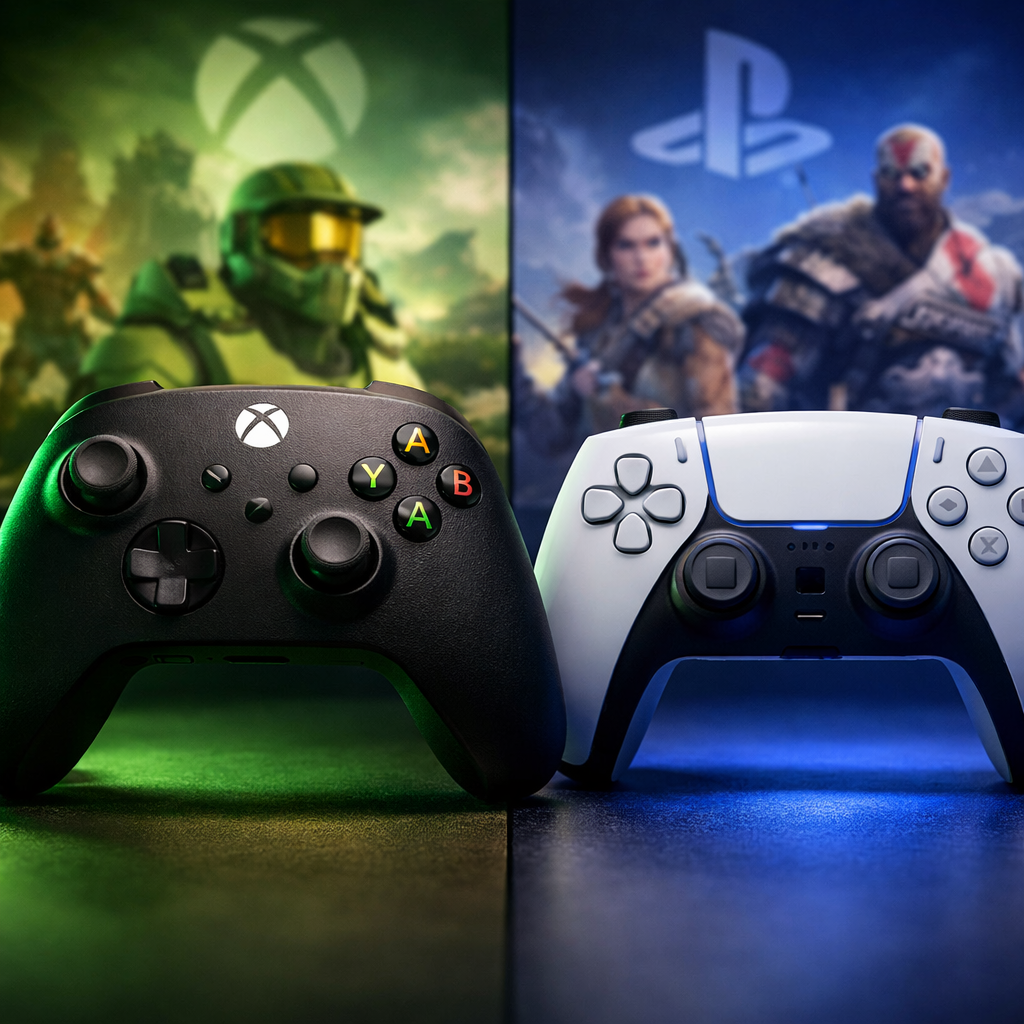
Choosing between Xbox Series X and PlayStation 5 often comes down to first-party exclusives and how you prefer to pay and play. Xbox emphasizes access: day-one releases on Game Pass, broad backward compatibility, and strong PC integration. PlayStation focuses on premium, buy-to-own blockbusters with standout DualSense immersion and ultra-fast I/O that reduce load times and stream high-fidelity worlds efficiently. While hardware power is broadly comparable in most cross-platform titles, first-party strategy changes the value you feel day to day. Below, we compare quality, quantity, variety, and availability—then tie those to ecosystem features, pricing, and realistic two-year costs so you can pick the console that fits your habits. Gaming Device Advisor keeps the focus on what you’ll actually play and what you’ll actually pay.
Strategic Overview
First-party game: A title developed or published by a platform holder’s internal studios and designed to showcase that platform’s strengths. These releases define a console ecosystem’s identity and can tip buying decisions.
On paper, Xbox Series X leads with a 12 TFLOPS GPU, an 8-core/3.8GHz CPU, and up to 560GB/s memory bandwidth, while PS5 counters with an 8-core/~3.5GHz CPU, a ~10.28 TFLOPS GPU, and a standout 5.5GB/s raw SSD throughput (8–9GB/s compressed). Despite spec differences, many cross-platform games play similarly, so policies and first-party execution often matter more than raw numbers, as summarized in Wired’s PS5 vs. Xbox guide (performance parity, services, and BC context) Wired PS5 vs. Xbox overview.
PS5’s fast storage and DualSense haptics/adaptive triggers are core to Sony’s premium feel and first-party optimization, while Xbox leans into ecosystem value—Game Pass day-one access for first-party titles, Quick Resume, Smart Delivery, and even Dolby Vision/Atmos support—detailed on Microsoft’s console compare page Xbox console features and Game Pass day-one. Backward compatibility breadth is also a differentiator: Xbox supports nearly all Xbox One games plus many Xbox 360 and original Xbox titles, significantly expanding day-one playable libraries Backward compatibility scope explained. PS5’s internal I/O and controller features are mapped spec-for-spec in IGN’s chart IGN PS5 vs. Xbox Series X specs and DualSense features.
How to compare first-party lineups
Look beyond “who has more games” and weigh:
- Quality: polish, performance targets, technical showcases
- Quantity: annual release cadence and back-catalog access
- Variety: genre spread and live service vs single-player epics
- Availability: day-one subscription access, PC parity, trials
- Ecosystem impact: controller features, cloud, cross-save
Day-one release: When a new first-party game is playable in a subscription the same day it hits retail, lowering upfront cost and encouraging trial.
Performance parity in many cross-platform titles puts the spotlight on first-party policies, I/O, and services (a dynamic highlighted in Wired’s head-to-head). Use a quick snapshot like this when deciding:
| Metric | Xbox Series X ecosystem | PlayStation 5 ecosystem |
|---|---|---|
| Est. major first-party releases/year | 2–4 across genres (variable cadence) | 1–3 larger, highly polished showcases |
| Day-one subscription availability | Yes for all first-party with Game Pass Ultimate | Rare at launch; added to PS Plus later |
| PC parity | Frequent day-one (Xbox + PC) | Select ports, often months/years later |
| Controller-specific features | Rumble + refined ergonomics; Quick Resume aids hopping | DualSense haptics/adaptive triggers add tactile depth |
| Typical catalog feel | Broad access and sampling | Premium, cinematic flagships |
What counts as first-party
“First-party” refers to games developed or published by the platform holder’s internal studios (e.g., Xbox Game Studios, Bethesda, Activision Blizzard under Microsoft; Sony Interactive Entertainment’s Worldwide Studios). These releases strategically highlight platform capabilities, drive subscriptions or premium sales, and often tap unique hardware features such as PS5’s DualSense or Xbox’s Quick Resume to stand out.
Counting rules used here:
- Include internally developed/published games, even if they launch on both console and the platform holder’s PC storefronts (Xbox day-one with PC parity counts).
- Exclude pure third-party timed exclusives not published by the platform holder.
Xbox Series X first-party strategy
Microsoft’s play is about access and continuity. Game Pass places all first-party titles in your library on day one; Quick Resume and Smart Delivery reduce friction, and Dolby Vision/Atmos, cross-save, and cloud features extend where and how you play (as outlined on Microsoft’s comparison page linked above). Backward compatibility increases your instant library dramatically at setup.
Studio portfolio and release cadence
Xbox’s acquisitions expand breadth across RPGs (Bethesda Game Studios, Obsidian), racers (Turn 10, Playground), shooters and service titles (343 Industries, id Software), and family/creative experiences (Mojang). The aim: a steadier drip of releases feeding Game Pass. Cross-launching on PC and cloud broadens reach but can dilute the “only-on-console” perception, reframing “quantity” as “quantity you can play right now.”
Game Pass day-one model and value
Game Pass (Ultimate) includes hundreds of games and day-one access to every Xbox first-party release. This trial-friendly model reduces risk and promotes genre sampling; for many players over 12–24 months, that feels like “more” even if raw counts align.
Example value comparison:
- Buy-to-own: 4 first-party games/year × $69.99 = ~$280/year
- Game Pass Ultimate: $19.99/month example = ~$240/year If you sample widely or play co-op across devices, the subscription’s net value often wins.
Backward compatibility and PC integration impact
Xbox supports nearly all Xbox One games plus many Xbox 360 and original Xbox titles, effectively enlarging the first-day catalog (and many legacy titles benefit from auto-HDR or frame-rate boosts). Cross-save/cross-progression: carrying progress across devices (console, PC, cloud) reduces friction. Quick Resume makes revisiting that legacy library nearly instant.
PlayStation 5 first-party strategy
Sony prioritizes polished, cinematic experiences that spotlight PS5’s hardware: the 5.5GB/s raw SSD (8–9GB/s compressed) enables fast loads and detailed streaming, while DualSense haptics and adaptive triggers add convincing tactile feedback (see IGN’s comparison linked earlier). Independent testing often notes PS5’s storage design is significantly faster in practice than Series X’s approach What Hi-Fi’s PS5 vs Xbox breakdown. In many third-party cases, performance is broadly similar, but first-party optimization is a clear differentiator.
Studio portfolio and release cadence
Flagship studios—Naughty Dog, Santa Monica Studio, Guerrilla, Insomniac—regularly deliver narrative-forward action-adventures and expansive open worlds with meticulous polish. The cadence skews toward fewer, larger releases that become platform tentpoles and define PS5’s identity for single-player enthusiasts.
Premium release model and polish
Premium release model: First-party games launch as full-price purchases rather than day-one subscription drops, emphasizing ownership and high production values. DualSense-driven immersion (nuanced haptics, adaptive trigger tension) contributes to the “premium” feel and distinctiveness of Sony’s first-party portfolio.
DualSense-enhanced experiences
Haptics: Advanced vibration patterns simulate textures, impacts, and environmental cues so actions feel lifelike and context-specific. Moments where DualSense elevates play:
- Bowstring tension tightening under your finger
- Slick vs. rough terrain changing trigger resistance
- Raindrops, recoil, and gear shifts conveyed through nuanced rumble
- Spatial cues via subtle vibrations guiding exploration
Quality, quantity, and variety comparison
The answer to “Which offers more first-party titles?” depends on whether you value maximum access (Xbox) or premium, buy-to-own showcases (PlayStation). Many cross-platform games perform similarly, so first-party strategy and ecosystem policies often decide the feel of the library.
| Dimension | Xbox Series X | PlayStation 5 |
|---|---|---|
| Annual release volume (est.) | 2–4 first-party drops, plus legacy breadth via BC | 1–3 flagship, high-budget releases |
| Genre coverage | Broad: RPGs, racers, FPS, survival/crafting, co-op | Deep in cinematic action-adventure/open-world; selective live service |
| Day-one subscription | Yes for first-party (Game Pass Ultimate) | Generally no at launch |
| Controller differentiators | Consistent ergonomics; platform QoL (Quick Resume) | DualSense haptics/triggers for tactile immersion |
| Reception indicators | Strong value/access perception | Strong polish/production-value perception |
Volume of releases and genres covered
- Xbox: Often “more accessible” first-party options via Game Pass day-one and backward compatibility breadth; variety across RPGs, racers, shooters, platformers, and live service/co-op.
- PlayStation: Fewer but larger narrative projects anchoring action-adventure and open-world, with selective pushes into live service; single-player epics remain the spotlight.
Critical reception and technical execution
Xbox holds an on-paper spec edge (12 TFLOPS GPU, higher memory bandwidth), while PS5’s I/O pipeline and optimization often deliver standout load times and streaming. Optimization: tuning a game to leverage specific hardware pipelines (SSD I/O, controller APIs) for faster loads, better responsiveness, and higher fidelity. In user ratings on Versus.com’s comparison, Xbox Series X averages 9.3/10 vs PS5’s 8.7/10 overall, and 9.4/10 vs 7.6/10 for backward compatibility, reflecting value perceptions as much as raw performance Versus console comparison and user ratings.
Multiplayer, live service, and single-player depth
- Best for solo narrative immersion: PS5’s cinematic first-party with DualSense
- Best for drop-in multiplayer and co-op variety: Xbox with Game Pass and cloud continuity
- Best for subscription explorers: Xbox’s day-one first-party model
Representative examples:
- Solo epics: PS5’s cinematic action-adventures
- Multiplayer/live service: Xbox’s co-op, racers, and service-forward franchises
- RPG depth: Xbox’s expanding RPG slate via acquisitions
Ecosystem factors that shape first-party value
Ecosystem: The combined hardware, services, features, and policies that govern how games are purchased, installed, updated, shared, and played across devices.
| Feature | Xbox Series X | PlayStation 5 |
|---|---|---|
| Quick Resume | Yes (rapid swap among recent games) | No direct equivalent |
| Smart Delivery/auto-upgrades | Yes | Third-party dependent; platform-managed upgrades vary |
| Dolby Vision/Atmos for gaming | Dolby Vision and Atmos supported | Atmos supported in some contexts; no Dolby Vision gaming |
| Cloud saves/cross-progression | Broad across console, PC, and cloud | Cloud saves via PS Plus; cross-progression varies by title |
| Controller tech | Refined ergonomics; impulse triggers | DualSense haptics, adaptive triggers, mic array |
Xbox features above (Game Pass day-one, Quick Resume, Smart Delivery, Dolby Vision) are outlined on Microsoft’s console compare page (linked earlier). PS5’s lack of Dolby Vision gaming support is noted in What Hi-Fi’s comparison.
Subscription offerings and trial access
Game Pass Ultimate provides day-one first-party access, a large rotating library, cloud play, and EA Play—excellent for testing genres without commitment. PlayStation’s biggest first-party releases typically launch as premium purchases, with subscription access added later. Decision rule: prioritize subscriptions/trials → lean Xbox; prefer owning headline releases → lean PlayStation.
Cross-platform, cloud, and save continuity
Cloud gaming: Streaming titles from remote servers so you can play without local installs, often sharing your saves and profile. Xbox’s PC parity and cloud tools broaden first-party access without rebuying; continuity wins include cross-save, cross-buy, cross-progression, and family account management. PlayStation supports cloud saves (with PS Plus) and selective cloud streaming, with PC ports arriving later for some titles.
Backward compatibility and legacy libraries
Legacy library: Your existing collection of older-generation games you may want to replay with enhancements.
- Xbox: Supports nearly all Xbox One, plus many Xbox 360 and original Xbox titles; enhancements can include higher resolution, FPS Boost, and Auto HDR.
- PS5: Broad PS4 support; older-gen titles largely via cloud/PS Plus Classics rather than native support.
Mini-table:
| Aspect | Xbox Series X | PlayStation 5 |
|---|---|---|
| Supported generations | XB1 + many 360/OG | PS4 (native), earlier gens via streaming/catalog |
| Enhancements | Auto HDR, FPS Boost on select titles | Select patches; faster loads via SSD |
| Disc/digital support | Both, with many enhancements | Both for PS4 titles |
| Save import | Often supported; cross-gen friendly | Often supported for PS4 titles |
Pricing and ownership considerations
Over 24 months, total cost = console MSRP + subscription choices + number of first-party purchases + potential storage expansion. PS5 launched with 825GB internal SSD vs Xbox’s 1TB, which can influence storage add-on timing. Because many cross-platform games perform similarly, cost-of-play and library strategy frequently tip the scale.
Example 24‑month models (console cost excluded):
- Subscription-first (Xbox): Game Pass Ultimate ~$19.99/month → ~$480/2 years; buy select favorites later at discount
- Buy-to-own focus (PlayStation): 2 big first-party games/year × $69.99 × 2 years → ~$280; add PS Plus tier if desired for back catalog
Day-one access versus buy-to-own
- Day-one access (Xbox): Minimize upfront spend, play every first-party release at launch, sample more genres quickly.
- Buy-to-own (PlayStation): Pay upfront, keep favorites permanently, strong replay value for single-player epics. Checklist: Try many new games monthly → day-one model. Replay a few blockbusters for years → buy-to-own.
Long-term cost of play and library longevity
Scenario analysis:
- If you play 4–6 new first-party titles per year, a robust subscription often beats à la carte spending within 12–18 months.
- If you finish 1–2 blockbusters annually and revisit them, buying may cost less over 24–36 months. Backward compatibility and cross-progression extend library life on Xbox; plan storage early given PS5’s smaller internal SSD and large install sizes on both platforms.
Recommendation
High-level rule: Choose Xbox if you value subscription access, cross-platform continuity (console, PC, cloud), and broad backward compatibility; choose PlayStation if you value single-player, high-polish first-party exclusives with standout DualSense immersion. Performance in many cross-platform titles is similar; first-party strategy and services often decide the experience. One-glance chooser:
- Best value sampler: Xbox + Game Pass day-one
- Best premium single-player showcases: PS5 with DualSense and fast I/O User sentiment frequently praises Xbox’s backward compatibility and quiet operation, while PS5 earns kudos for controller innovation and first-party polish. If you’re undecided, Gaming Device Advisor prioritizes playstyle and budget over raw specs when making the call.
Frequently asked questions
Which platform offers more first-party titles: Xbox or PlayStation
Xbox surfaces more playable first-party options via Game Pass day one and broad backward compatibility; PlayStation delivers fewer but highly polished, premium blockbusters. Gaming Device Advisor recommends choosing based on whether you value access and variety (Xbox) or buy-to-own showcases (PlayStation).
Do Xbox first-party games still count if they launch on PC
Yes—if Microsoft develops or publishes them, they’re first-party regardless of a PC co-launch. Gaming Device Advisor notes PC parity expands access while cross-save/cloud features ease switching.
Are PlayStation first-party games coming to PC and how does that affect exclusivity
Some arrive on PC months or years later, but they remain first-party at launch. Gaming Device Advisor views the ports as audience expansion, not a loss of PS5 showcase value.
Does Game Pass reduce the need to buy first-party games outright
For many players, yes—day-one access makes it cost-effective if you try multiple releases each year. Gaming Device Advisor suggests collectors still buy favorites to keep permanently.
Will backward compatibility affect how many first-party games I can play on day one
Yes—broader backward compatibility means a larger instant library of legacy first-party titles at setup. Gaming Device Advisor recommends checking your existing library to gauge day-one value.