Recommended RGB Lights for Gamers: Budget to Premium, No Regrets
Recommended RGB Lights for Gamers: Budget to Premium, No Regrets
Gaming rooms in 2025 are lit by smarter, smoother LEDs: addressable RGB (often called RGBIC) that paints multiple colors at once, COB/CSP arrays that look seamless and bright, and higher CRI for more natural color—all tied into your smart home. Roundups consistently highlight these shifts alongside reliability and ecosystem fit for gamers who want plug-and-play immersion without hiccups, from budget to premium picks (see the HitLights 2025 overview and Strategist roundup), and they mirror our testing at Gaming Device Advisor. Our no-regrets guide below maps the best RGB lights for gaming desks and rooms 2025 across budgets, with clear trade-offs and placement tips.
We selected kits that avoid app headaches, mismatched ecosystems, and weak output. Each pick states who it’s for, why it stands out, and where it compromises—so you can choose addressable RGB effects, accurate whites (RGBW vs RGB), or COB LED strips for dot-free runs—and know if Wi‑Fi/Bluetooth, Matter, HomeKit, Alexa, or Google Assistant will fit your setup.
Gaming Device Advisor
At Gaming Device Advisor, our POV is simple: the best gaming room lighting balances immersion and color fidelity without adding noise, heat, or cable chaos. We prioritize value, app stability, and ecosystem longevity. Every pick here is editor-tested by our team and ranked using comparative scoring that weighs brightness and distribution, CRI, diffusion, effect quality, latency, platform support, and power/thermals.
Lighting should improve usability, not just vibes. Bias lighting behind monitors reduces eye strain and makes blacks look deeper, while well-routed power and modest hub overhead keep desks clean and quiet. If you’re still deciding between PC ARGB headers and standalone smart light strips, see our explainer on ARGB vs RGB ecosystems for gaming PCs.
How we test RGB lights for gaming setups
Addressable RGB (RGBIC) defined in 40–50 words: Addressable strips split the LED run into zones that can each display a different color simultaneously. That enables multi-zone waves, gradients, and reactive patterns that sync with game audio or visuals, dramatically boosting ambience over single-color strips while preserving smooth transitions across the run.
Our test matrix We apply the same thresholds across Gaming Device Advisor reviews for apples-to-apples results.
- Brightness and distribution
- We verify stated lumens per foot and check uniformity for bias, ambient, and task zones. Targets: accent 100–350 lm/ft; task 280–1000 lm/ft. See the Sunlite LED buyer’s guide for typical ranges and example power specs.
- Color fidelity
- We require CRI >80 and flag products that reach 90+ for natural skin tones and in-game art.
- App stability and ecosystem
- We score effect libraries, music/reactive modes, latency, and support for Matter, HomeKit, Alexa, and Google Assistant.
- Hardware quality
- Diffusion (COB/neon vs dotted), cut points, adhesive strength, connectors, and IP rating for placement.
- Power and drivers
- We confirm wattage, heat, and dimming range; game-room examples range from ~20W light bars/gradients to high-draw 72W addressable strips.
Market context: the RGB LED strip category is growing quickly, with forecasts projecting around USD 10.7B by 2032 at roughly 12.5% CAGR, underscoring rapid innovation and better value year over year.
What to look for in RGB lighting
- Addressable vs non-addressable
- Addressable strips render multiple colors across segments simultaneously; non-addressable shows one color along the whole strip. Choose addressable for game-sync and gradients; choose non-addressable for clean, uniform ambience.
- LED array: RGB vs RGBW/RGBWW; COB/CSP
- RGBW/RGBWW (45 words): RGBW adds a dedicated white LED so whites are brighter and more accurate for reading and content work. RGBWW adds both warm and cool white channels to tune color temperature. Both options lift daily usability and faithful whites beyond RGB-only strips, which mix white from colored diodes.
- COB LED strip (45 words): Chip-on-board arranges many tiny diodes under a continuous phosphor layer to produce a smooth, dot-free line of light with higher brightness. It’s ideal near reflective monitors, glass, or task surfaces where hotspots and visible LED “pixels” would be distracting, per the HitLights 2025 overview.
- Brightness targets
- Aim for accent/bias at 100–350 lm/ft and task at 280–1000 lm/ft. Bedrooms often feel balanced around roughly 375–562 lm/ft when diffused.
- Protection/IP
- Match the IP rating to placement: IP20 for clean indoor surfaces; IP54/IP67 when you need silicone encapsulation or splash/water resistance. Lumilum’s IP rating primer covers typical use cases.
- Connectivity
- Wi‑Fi/Bluetooth affects latency and reliability; some ecosystems need a hub (e.g., Hue) for scenes, remote control, or Matter bridging. Confirm HomeKit, Alexa, Google Assistant, and Matter support before you buy.
Pro tip: Check cut points and available connectors before mounting; most strips are field-cuttable, but spacing and voltage vary by model.
1. Apex RGBIC and Apex Neon Rope
Who it’s for: First-time buyers and renters who want addressable effects and voice control at friendly prices.
Why we like it: Apex’s budget kits lean on RGBIC for multi-zone gradients, include Alexa/Google support, and pair with the familiar Smart Life app. The Apex Neon Rope adds silicone “neon” diffusion for a continuous, dot-free look—great for visible runs and streamer backdrops, as noted in Apexlight’s 2025 round-up.
Best uses
- Desk edges, shelf accents, or under-monitor bias if you want dynamic effects without premium pricing.
- Neon Rope for exposed perimeter lines where smooth diffusion matters.
Trade-offs
- Budget apps can feel clunky and may offer fewer polished scenes.
- Verify cut/extend options and the IP rating if routing near PCs or floors with occasional cleaning splashes.
2. Wyze Light Strip and Kasa Smart Light Strip
Who it’s for: Ultra-value shoppers who want reliable voice control and simple installs without multi-zone effects.
Why we like it: Wyze’s app is quick to set up and adds useful routines like Sleep and Vacation modes, keeping daily control simple. However, Wyze’s base light strips are non-addressable—sound-reactive but one color at a time—best for uniform ambience rather than gradients, as covered in Reviewed’s smart light strip guide.
Ideal placements
- Back-of-desk glow behind monitors, toe-kicks, or clean shelf runs.
- Kasa offers similar value and dependable Alexa/Google support; check brightness per foot if you need more output.
3. Govee M1 and Govee COB Pro
Who it’s for: Gamers who want big, reactive, addressable effects and can live with a busy app.
Why we like it: The Govee M1 is a flagship addressable RGBIC strip with robust music sync, room-scale gradients, and high brightness; its spec sheet lists up to 72W draw in longer kits, so plan power accordingly. Some users find the app powerful yet a mixed bag in polish compared with more curated ecosystems. The Govee COB Pro trades “pixels” for near-continuous light and softer reflections—better behind glossy ultrawide panels or along visible trim, aligning with COB diffusion advantages described in the HitLights 2025 overview.
Best uses
- Perimeter walls, ceiling coves, or long desk runs for maximal scene variety.
- Bias lighting behind ultrawide monitors or TV backdrops where hotspot-free COB matters.
Notes
- Test scenes and music modes before permanent mounting.
- High wattage means you should plan outlets, cable routing, and potential extensions up front.
4. HitLights COB and CSP Strips
Who it’s for: Prosumer builders and hybrid gaming/work desks who need premium diffusion and strong color accuracy.
Why we like it: HitLights’ COB/CSP options deliver continuous, dot-free output with high lumen density—excellent for task surfaces and top-tier bias lighting. In our testing at Gaming Device Advisor, these strips reach bright accent levels (around ~1000 lm/m class) while maintaining clean diffusion, and CRI commonly exceeds our 80 baseline, with 90+ variants for better skin tones and art fidelity.
Practical tips
- Ideal behind monitors, under shelves, or in PC cases where hotspots are unacceptable.
- Plan drivers and wiring carefully: consider voltage drop on long runs, use proper connectors, and verify IP ratings for the location.
5. Philips Hue Gradient and Hue Solo
Who it’s for: Premium users already in the Hue ecosystem or anyone prioritizing accurate whites, automations, and rock-solid reliability.
Why we like it: Hue Gradient delivers addressable multi-color effects in a refined package with Alexa, Google, and Siri support. Typical Gradient kits are around 20W, and while upfront cost is high (~$180 for ~80 inches), Hue’s hub-backed ecosystem is stable and expansive. Within Hue, the new Hue Solo focuses on RGBWW accuracy and brightness for everyday use but is non-addressable—single color at a time—making it the better choice if true whites and tunable warmth/coolness matter most, as noted by the Strategist.
Notes
- Hue generally needs its Bridge for full features and Matter integration.
- Extensions and accessories are plentiful, but costs add up; plan the whole room.
6. LIFX Light Strip and Eve Light Strip
Who it’s for: Apple-first homes and advanced smart-home users who prize color, scenes, and deep HomeKit/Matter alignment.
Why we like it: LIFX is known for vivid color and rich effects with granular control, while Eve’s Light Strip integrates cleanly with HomeKit and Thread/Matter in Apple-centric setups. Confirm addressable capability per kit and whether you’re getting RGBW/RGBWW for better whites.
Suggested setups
- Accent walls behind monitors, shelves, and sync-friendly zones where Siri scenes and automations shine.
- Great fit if you’re consolidating around HomeKit or expanding a Thread/Matter mesh.
Installation tips and common mistakes to avoid
- Measure twice, cut once: confirm cut points and lengths before peeling adhesive.
- Match IP rating to placement: IP20 for clean indoor runs; IP54/IP67 for protected or splash-prone areas, per Lumilum’s IP guidance.
- Plan power early: total the wattage, include driver headroom, and route cables cleanly—high-draw kits like the Govee M1 (~72W) need appropriate outlets.
- Dry-fit and test: run scenes and music sync before permanent mounting to align corners and diffuser channels.
- Avoid hotspots and flicker:
- Choose COB or neon-style strips for exposed runs to minimize visible LED dots.
- Keep runs within recommended lengths or add repeaters to limit voltage drop; use quality drivers for stable dimming.
- Safety note: Prefer 12V/24V low-voltage strips around desks and beds; 120V “neon rope” is typically a commercial product with different handling and safety needs, as BirdDog notes in its trends brief.
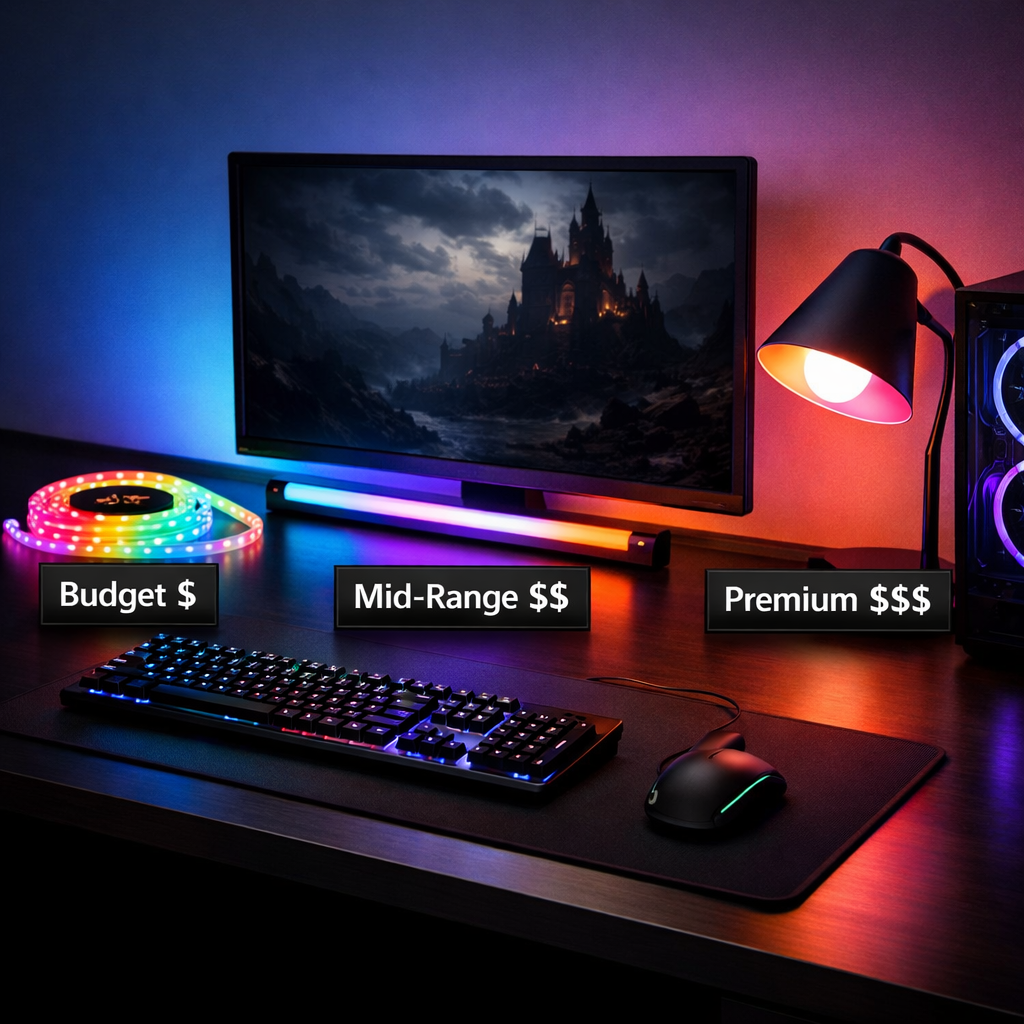
Value tiers and who should buy what
Budget
- Picks: Apex RGBIC/Neon Rope; Wyze/Kasa for simple ambient.
- Best for: First-time setups, renters, clean bias lighting and shelf accents.
- Brightness aim: 100–350 lm/ft for accents; add diffusion behind glossy panels.
Mid-range
- Picks: Govee M1 for maximal addressable effects; Govee COB Pro for dot-free output.
- Best for: Streamers, ultra-wide desks, room-scale gradients and music sync.
- Brightness aim: 100–350 lm/ft for ambience; 280–1000 lm/ft where task lighting overlaps.
Premium
- Picks: Philips Hue Gradient/Hue Solo; LIFX/Eve for ecosystem reliability and Apple-first homes.
- Best for: Tunable whites, dependable automations, long-term ecosystem growth (including Matter/HomeKit).
- Brightness aim: Similar targets; lean on RGBW/RGBWW for everyday clarity and accurate whites.
Quick decision rules
- Want game-sync multi-zone gradients? Choose addressable (RGBIC).
- Need true whites for reading/content? Choose RGBW or RGBWW (Hue, Solo, or similar).
- Visible runs with no hotspots? Choose COB or neon-style diffusion.
Frequently asked questions
Are addressable RGB strips worth it for gaming immersion?
Yes. In Gaming Device Advisor tests, addressable (RGBIC) strips deliver gradients and reactive effects non-addressable strips can’t match.
How bright should RGB strips be for a desk or monitor setup?
For bias and desk accents, aim for 100–350 lumens per foot; for task work around your setup, target 280–1000 lumens per foot with diffusion to reduce glare. Those are the targets we use in Gaming Device Advisor reviews.
Do I need RGBW or tunable white for accurate whites?
If you care about true whites for reading or creative work, pick RGBW or RGBWW—they add white LEDs for brighter, more accurate whites than RGB-only strips. That’s why we call out RGBW/RGBWW options in our picks.
Will these lights work with my smart home platform?
Most budget and mid picks support Alexa and Google Assistant. For Apple homes, look for HomeKit-native or Matter/Thread devices; Gaming Device Advisor pick notes call this out, and some ecosystems require a hub for full features.
How do I avoid hotspots, flicker, and app instability?
Use COB or neon-style strips for smooth diffusion and plan power and run lengths to prevent voltage drop. Choose reputable ecosystems with stable apps—Gaming Device Advisor reviews flag these issues before you buy.